
Prana


Caspar David Friedrich - Der einsame Baum, 1822
Our breath is the thread that connects what we feel with what we do. It is the bridge between our central and peripheral nervous systems. To experience its more potent capabilities, breath is prescribed in deep doses.
Breathing is unique in the sense that we can consciously control it through active breathing but it can also assume a subconscious or more passive role.
In yoga classes I teach, I always emphasize the importance of aligning your movements with your breath over anything else. In yoga classes where I practice, as well as in dance and martial arts, I always strive to remain mindful of this alignment and carry it with me off my mat and into the rest of my day.
This article contains some reflections on breathing, the science behind it and suggests some breathing exercises that have helped me navigate the good and the bad (with a challenge at the end).
PS yes, I will continue writing separately about geopolitics, defense and technology.
Breath. It is always there. It will do its thing if you leave it alone. But boy will it thrive if you give it some attention and regulate it with intent. You can always rely on your prana- sanskrit for breath. Your prana (breath) is effectively your body’s fire extinguisher behind the break in case of emergency glass.
Prana is interestingly defined as both breath and life force, soul or spirit by a number of the great ancient cultures including Hebrew (ruach), Greek (pneuma) and Latin (spiritus). It seems a whole host of people with no shortage of disagreements reached similar conclusions about human breath: it is an act as spiritual as it is physical.
Many of us today, particularly those caught up in corporate life, are unaware of the wide ranging benefits of dedicated breathing practices, but it is encouraging to see a nascent and growing body of scientific medical literature that documents the results of isolating breath as a variable of study in controlled, randomized clinical trials.
Science today is beginning to validate a classical precept: if you learn how to regulate your breath with intent, you can experience a whole host of corresponding physical, psychological and physiological benefits.
Breathing practices have been described as “natural tranquilizers for the nervous system” and unlike pharmaceutical tranquilizers, whose effectiveness and potency diminishes overtime, natural breath-based tranquilizers can remain a reliable source of relief throughout your lifetime.
Many breathing techniques and methods, like the 4-7-8 or alternative nostril, often trace their roots to the yogic practice of pranayama and have become popularized in modern culture as tools to reduce your anxiety and stress while improving your physiological functions (such as sleep and digestion).
This article will focus on exploring the 4-7-8 technique (my favourite). 4-7-8 can serve as an easy and useful backpocket tool for a whole host of real time and longer term benefits.
If you already practice some form of yoga, dance, martial arts or meditation, this technique will only complement your practice. If not, a standalone breathing practice will still bring you plenty of benefits. At least it has for me.
4-7-8
What is it? The 4-7-8 method is a breathing technique developed by Dr Andrew Weil that anyone can use (and I have) to activate their parasympathetic nervous system to calm the body and experience the benefits of relaxation.
Easy As 1-2-3
Is this your first time? Follow these steps and keep these tips in mind…
Sit upright and comfortably
Breathe out the air in your lungs
Have the tip of your tongue touch the back of your front two teeth
Inhale to the count of 4
Hold to the count of 7
Exhale out of your mouth, making a “whoosh” sound, to the count of 8
Repeat this three more times for four breath cycles (or one breath set) with your eyes opened or closed. Once you become more comfortable, you can practice this technique laying down as well.
Being guided can take you far- this could help first timers progress. This is an excellent follow-along I recommend you try:
Ratios Matter More
Is breathing in for four seconds too much? Experiencing difficulties holding your breath for seven? No stress. What matters here are the ratios, not the duration. So, instead of 4-7-8 you can try starting with 2 seconds of breath, 3.5 seconds of hold, and 4 seconds of exhale.
Stick with this and it might surprise you how quickly you will be able to progress to 4-7-8.
The Minimum Effective Dose
A minimum effective dose of at least 2 breath sets per day is recommended to experience the benefits of this technique.
While it takes 4-6 weeks of practice for your nervous system to adapt to an activated parasympathetic state and more fully realize the benefits of this technique, there are immediate positive effects this form of pranayama can bring you in the moment such as:
- Lower heart rate and blood pressure
- Reduced anxiety
- Improved sleep
Happy Breathing!
Have you tried this before? Did you just try it now? Intentional inhales have been a critical component of my natural anti-inflammatory regime. If you want to dive deeper into the details and the science behind the technique, then keep reading.
Andrew Weil, a doctor, professor and founder and director of the Andrew Weil Center for Integrative Medicine at the University of Arizona, developed the 4-7-8 breathing technique and described it as a “natural tranquilizer for the nervous system”.
Your regular breath strikes a balance between inhaling oxygen and exhaling carbon dioxide. The 4-7-8- exercise upsets this balance by forcing you to exhale more than you inhale. This leads to a sudden drop of carbon dioxide in your body, which may produce that feeling of lightheadedness for starting practitioners.
So if you start feeling lightheaded, that is normal and not a cause for panic (does anything really justify panic?). If you feel your body will let you continue that moment, then proceed. Otherwise, you can try again in a few hours or the next day.
Show me the science
Does our good friend empirical science support the claims above? Yes..and no. There is a clear shortage of large randomized controlled clinical trials that seek to isolate and study the impact of breathing techniques like 4-7-8 as a variable in the activation of the parasympathetic nervous system.
Here is a convenient explanation of the important connection between deep, slow breathing and an active parasympathetic state:
“The sympathetic nervous system controls your body's stress response. The parasympathetic nervous system controls your body's rest and relaxation response. This is why deep breathing is so effective at causing the relaxation response.” As you see below, when you activate one of these systems, you automatically suppress the other.
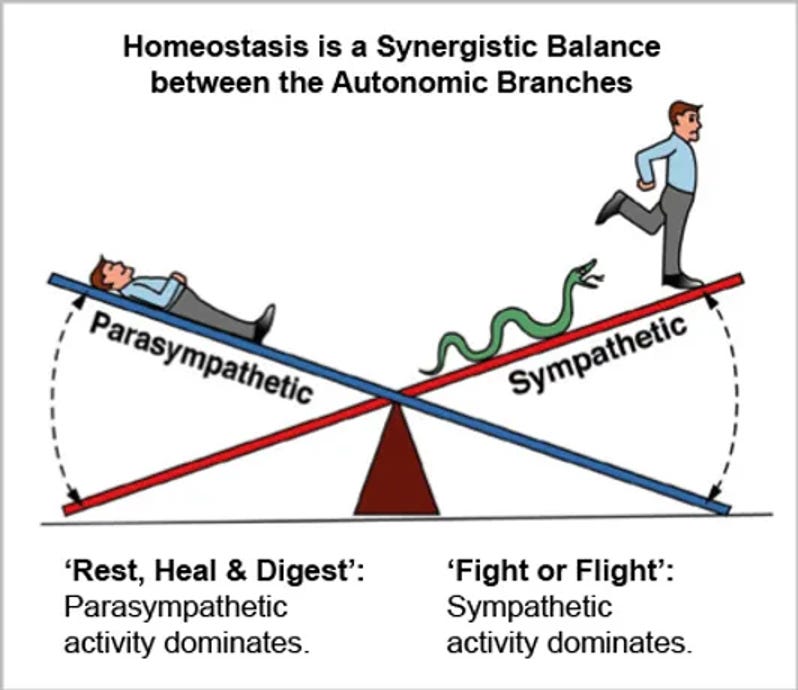
Studies to date have revealed positive relationships between a regular practice of breathing techniques and factors such as heart variability and blood pressure, that merit greater study and attention in Western medical treatments.
It is encouraging to see that doctors, health specialists and even legacy news media outlets like CNN have all contributed to the conversation around breathing techniques in general and the 4-7-8 method in particular.
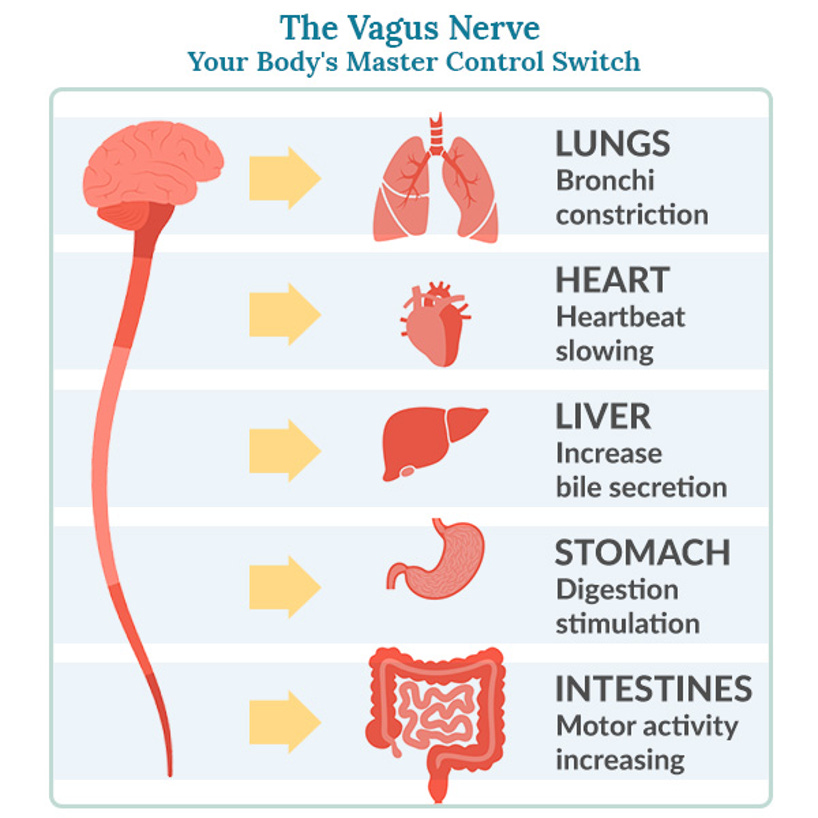
From what we know about our brain and body, we know the parasympathetic nervous system is the axis upon which key restorative functions, such as heart rate, blood pressure, digestion, and pupil contraction, are largely regulated by the vagus nerve.
We also know our vagus nerve, which runs from your brain to your stomach and is key to our hypothalamus- pituitary gland-adrenal gland (HPA) axis (see an earlier post on this), can be stimulated by our breath. While you can do lots to stimulate your parasympathetic nervous system, from getting a massage to temporarily freezing in a cryo-chamber or going on vacation, most of these activities are not good candidates for instant stress relief solutions.
Challenge:
Here is a simple, practical challenge to help you experience the science behind this directly: try being simultaneously upset, frustrated or stressed in the actual moments you are engaged in the deep, deliberate, rhythmic breath patterns of the 4-7-8 technique. It simply is not possible. You are either engaged in the activation of your sympathetic nervous (upset, frustrated, stressed) or parasympathetic nervous system (relaxed, restful, regenerative). Not both.
Stay tuned for more. Happy Breathing!